
Disclaimer: Please read the fundamentals of Jobs to be done before reading this article
Designing products has long been considered as somebody’s hidden pain or idea. However, starting the ideation process must be rooted in a scientific process as we do not actually know whether what we are thinking on behalf of the end user is what the actual user is also thinking.
The following exert is from Eyal, Nir. “Hooked: How to Build Habit-Forming Products” and is quite appropriate here.
“These common needs are timeless and universal. But talking to users to reveal these wants will likely prove ineffective since they themselves don’t know which emotions motivate them. People just don’ think in these terms. You’ll often find that people’s “declared preferences” on what they say they want are far different from their “revealed preferences” on what they actually do”.
Modern product development has evolved from idea driven to need driven landscape using frameworks like Jobs to be Done. The problem with innovation process has been mostly an idea originating in someone’s head and executing it further. It went into a black box and until the idea was successful or failure there was no known methods to know early. This landscape got changed with methods like lean startup MVP using JTBD. JTBD is a technique to identify the goals of the user and track its progress he makes in a given context. Using JTBD you are able to identify the primary choice the user makes the main job which is like a north star regardless of the solution or technology.
Some of methods on how to identify the primary jobs could be learnt here:
Everyone Says Focus On Outcomes Few Understand What It Takes
why do so many product discoveries fail even when they are based on customer research
Solving the Innovation Problem with Human Science
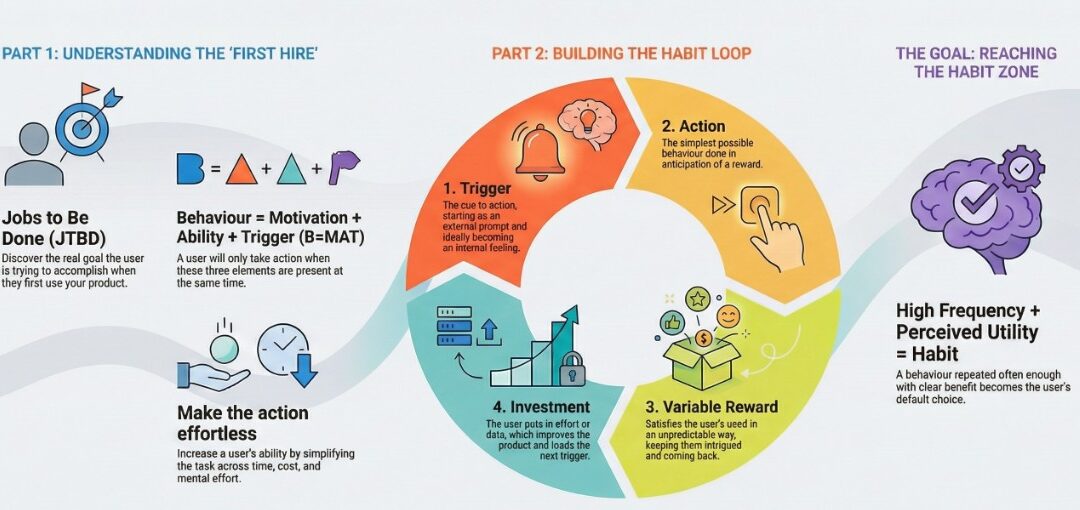
Humans are largely driven by behaviors. The key is to link the causal mechanism of human progress (using JTBD) with human behavior so that habit formation has the maximum possibility. JTBD is a choice that the user has taken to hire a product as the means to meet his goals and the Hook model provides structure to design the experience that ensures unprompted repeat engagement. This is our fundamental problem of innovation: inability to predict whether the consumer will engage with the product for life
Based on psychologist Dr. B. J. Fogg’s model, any behavior occurs only when three factors are present.
B = M + A + T
- Motivation: Every behavior is driven by one of three Core Motivators that drive all human action:
- Seeking pleasure and avoiding pain.
- Seeking hope and avoiding fear.
- Seeking social acceptance and avoiding rejection.
- Ability: Ability is influenced by the six factors of time, money, physical effort, brain cycles, social deviance, and non-routineness. Ability is dependent on users and their context at that moment.
- Triggers: There could be external triggers which could be UI driven a button click etc but the design which is based on internal trigger goes a long way. The ideal state is when these external triggers lead to an internal trigger within the user’s mind. This is where one should lean into jobs to be done model to borrow the functional, emotional and social job and connect these to the external trigger design through the application which could be a button click, a newsletter, email etc.
Ability is the user’s capacity to perform a particular behaviour, and simplicity is a function of the user’s scarcest resource at that moment. Product designers increase the likelihood of action by removing obstacles across these six factors:
- Time: How long the action takes to complete.
- Money: The fiscal cost of taking the action.
- Physical Effort: The amount of physical labour involved in taking the action.
- Brain Cycles: The level of mental effort and focus required (i.e., avoiding a confusing interface).
- Social Deviance: How accepted the behaviour is by others (avoiding a behaviour that could be seen as inappropriate).
- Non-Routine: How much the action disrupts existing user routines.
By simplifying the task using these elements, a designer helps push the user across the “Action Line” in the B = MAT formula, ensuring the job gets done easily.
While JTBD shapes the landscape of “Why the product would be hired for first use” the hook model carves the experience of repeat behaviour. If you are trying to find the struggling moment, JTBD is the right tool because it starts with context: the situation that triggers the need, the friction in the current approach, and the person’s progression towards it. To make it a habit and the product gets hired repeatedly we should lean on the Hook model.
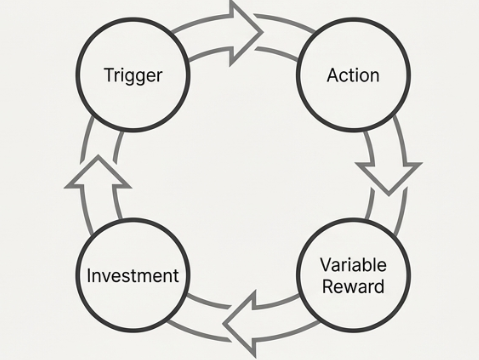
One of the steps to see the struggles of progress towards the goal that the consumer is making is through Job mapping. The logical stages in job mapping along with the internal triggers associated can be a strong indicator to start thinking from “their” perspective. The emotional state the user is in during the step. For instance, if the Job Step is Check inventory, the “5th Why” (not limited to asking 5 times though) might reveal a fear of being unprepared. At this stage you might consider firing an external trigger for action via a notification or email for the consumer.
The Action: To fulfill the micro jobs
Action is the simplest behaviour done in anticipation of a reward. For a habit to form, action should be simpler than thinking. The action phase is possible based on Fogg Model (B=MAT) when all of this is present. As the job map helps uncover the related micro jobs our responsibility during the action phase is to find opportunity to simplify the action as much as possible. A salient example of this principle in practice is the Netflix play next interaction. Historically, deciding what to watch was a cognitively demanding process requiring a user to browse long catalogues, look for genres, read descriptions, compare options, and repeatedly commit to choices that often felt uncertain. To fulfil the Micro-Job of “starting entertainment quickly” with maximum simplicity, Netflix made viewing launchable via a single prominent Play action with auto preview and a near frictionless transition into the next episode, bypassing the need for repeated decision making and reducing the need to think about the process
The Variable Reward: Post the action
From a first-principles perspective, the Reward phase must provide a “relief” for the internal trigger (often the desire to escape, relax, or resolve boredom) while maintaining an element of novelty that suppresses the brain’s reasoning centres and activates the dopamine system. In the context of Netflix viewing, the rewards are often multi-dimensional. Grounded in Self-Determination Theory (Deci and Ryan), this reward manifests as the immediate gratification of finding something that matches the mood and completing an episode or storyline. There is a sense of competency in picking the right show, staying on track with a series, or mastering personal taste through better choices over time. When the user starts a show, they are “capturing” an experience or resource. The variability lies in the outcome. Is the episode satisfying, does the story twist, is the next episode better than expected? This uncertainty creates a focused state that compels the user to keep hunting by continuing, sampling, or switching episodes.
The Investment: Refining the experiance
The final phase of the Hook involves the user “storing value” in the system. Unlike the Action phase, which aims to reduce friction, the Investment phase involves a bit of work that makes the product better with use and increases “switching costs” through the IKEA Effect the psychological tendency to irrationally overvalue that which we have laboured to create.
Every title watched, every series followed, and every item added to My List becomes a unit of content stored in the user’s profile. Over time, this becomes a “repository” of taste and viewing history. As this library grows, the service becomes a “treasured asset” that the user is less likely to abandon for a competitor. By rating the content implicitly through watch time, saving titles, and building lists, the user provides the system with data that improves future recommendations. This expertise moves them along the “Ability” axis of the Fogg Behaviour Model, making Netflix the path of least resistance into the habit zone. You might be wondering how is it possible? A behaviour that occurs enough times with perceived utility enters the habit zone and mind treats it as the new default behaviour.
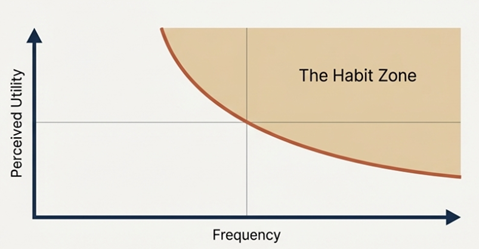
Products that form outside of the habit zone are merely conscious actions. Habit forming products often start as “vitamins” (nice to haves) and once habit is formed becomes the “painkillers” (must haves). A critical second-order effect of the Investment phase is that it “loads the next trigger”. Having a watch history, followed series, and saved list items (the Investment) enables the system to send future external triggers such as new season alerts, because you watched suggestions, or continue watching prompts. These external cues eventually transition back into Internal Triggers, where the mere sensation of boredom, fatigue, or the desire for relief prompts the user to open Netflix to either continue a series or hunt for something new, completing the cycle of unprompted user engagement. In this way, Netflix is not merely a content library; it is a meticulously engineered “habit forming ” product.
Here’s a reward for you for the time spent reading my blog: Get a free Value Hypothesis Canvas. Please request access.
References : Hooked