
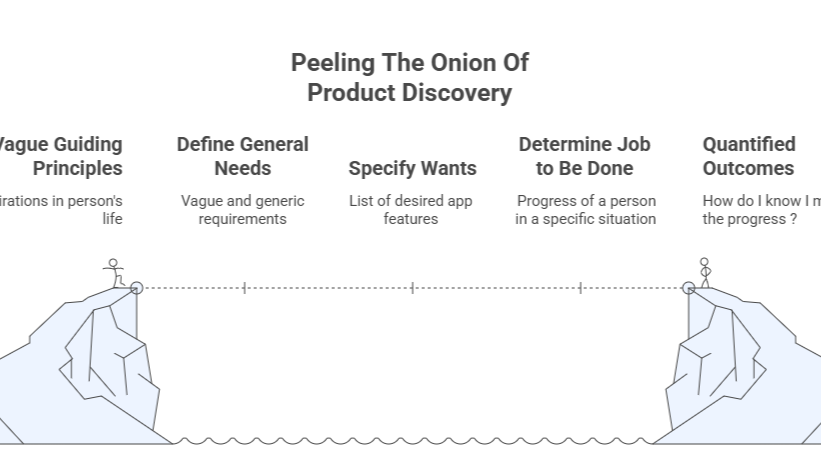
Because most teams stop peeling the onion too early. They confuse principles, needs, or wants with the real progress customers are trying to make (the Job to Be Done).
1. Guiding Principles (too abstract)
Example: “I want to be organized and successful in my career.”
→ True, but too sweeping to build around.
What they are: Broad life aspirations or values.
Why they’re not a Job: Too abstract to trigger a customer to pull one product over another. You can’t design around this without knowing the specific situation.
2. General Needs (too vague)
Example: “I need to remember things” or “I need to manage information.”
→ Doesn’t explain why they’d pick your app over sticky notes or Google Docs.
What they are: Always-true, generic requirements.
Why they’re not a Job: They don’t explain context or why one solution is chosen over another. A need alone doesn’t create demand—people often skip solutions even when the need exists.
3. Wants / Preferences (solution-focused)
Example: “I want dark mode,” “It should sync across devices,” “I want it free with lots of storage.”
→ These are feature requests, not struggles.
What they are: Customer desires about features or product traits.
Why they’re not a Job: They describe a solution, not the underlying progress. If all answers come from the same product class, you’re looking at a want, not a job.
4. Job to Be Done (specific progress in context)
Example: “When I’m in back-to-back meetings all day, help me capture key decisions quickly so I don’t drop the ball and can follow up confidently.”
→ Now the competition is broader: notebooks, audio recordings, even asking a colleague to take notes.
What it is: The progress a person is trying to make in a specific situation (functional, social, and emotional).
Why it matters: It creates an innovation blueprint. A well-defined job is expressed in verbs + nouns, focusing on the action and desired outcome.
Peeling Further → Micro Jobs
Before a meeting:
-
“Remind me what was decided last time.”
-
“Show me who’s attending and the agenda.”
During a meeting:
-
“Capture decisions without losing focus.”
-
“Flag action items separately.”
-
“Tag responsibilities in real time.”
After a meeting:
-
“Summarize clearly so I don’t reread raw notes.”
-
“Send action items automatically.”
-
“Make sure I can retrieve this later.”
Outcomes (how progress is measured)
-
Minimize time to find past decisions.
-
Increase accuracy of action-item ownership.
-
Minimize delay between meeting end and follow-up.
Quantified Targets
-
Find past decisions in <30 seconds.
-
Capture action items with 95%+ accuracy.
-
Share a usable summary in under 5 minutes.
The Peel in Action
-
Principle: Be successful and organized.
-
Need: Remember and manage information.
-
Want: Dark mode, syncing, free.
-
Job: Capture and retrieve meeting decisions fast so I can act without missing details.
-
Micro Jobs & Outcomes: Prep → Capture → Organize → Share → Retrieve (measured by time, accuracy, confidence).
👉 If you stop at principles, needs, or wants you’ll build features.
👉 If you peel down to jobs, micro jobs, and outcomes you’ll build real progress.